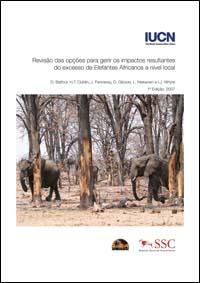
Revisão das opções para gerir os impactos resultantes do excesso de Elefantes Africanos a nível local
Publication
2007
As the World Heritage Convention celebrates its 50th anniversary in 2022, over 1100 sites around the world are recognized as World Heritage – places that are so valuable to humanity that there conservation has been deemed our collective responsibility. Yet many of these exceptional places face increasing pressure from diverse types of development projects within and around the sites. Assessing the impacts of such projects is essential to both prevent damage to World Heritage and identify sustainable options. This Guidance and toolkit explains the process for achieving these goals. Offering practical tips and tools including checklists and a glossary, it provides a framework for conducting impact assessments for cultural and natural heritage sites.
Guatemala is considered as one of the countries most vulnerable to climate change, facing threats to water and food security as well as livelihoods. Despite this, climate action has received insufficient consideration in the country’s development agenda and local planning.
To address these issues, the EbA-LAC program has collaborated with relevant institutional teams to establish a joint approach towards guiding municipalities in the incorporation of climate considerations into their planning and budgeting processes. Through advocacy actions, key actors have updated the public investment system to include adaptation products, providing a procedural framework for municipalities to access funding and include adaptation measures in municipal budgets. In addition, by improving inter-institutional coordination, facilitating joint municipal planning tools, as well as strengthening municipalitechnical capacities, EbA-LAC has succeeded in paving the way for municipalities to leverage synergies towards an increased resilience.
Unite for Nature on the Path to 2045: A 20-Year Strategic Vision for the Union articulates IUCN’s commitment to “a just world that values and conserves nature” and establishes a clear direction for the next two decades. It guides collective efforts to safeguard biodiversity, inspire societal engagement, and drive transformative change toward a sustainable future.
Unite for Nature on the Path to 2045: A 20-Year Strategic Vision for the Union articulates IUCN’s commitment to “a just world that values and conserves nature” and establishes a clear direction for the next two decades. It guides collective efforts to safeguard biodiversity, inspire societal engagement, and drive transformative change toward a sustainable future.
Unite for Nature on the Path to 2045: A 20-Year Strategic Vision for the Union articulates IUCN’s commitment to “a just world that values and conserves nature” and establishes a clear direction for the next two decades. It guides collective efforts to safeguard biodiversity, inspire societal engagement, and drive transformative change toward a sustainable future.
«Unidos por la naturaleza en el camino hacia 2045: una visión estratégica de 20 años para la Unión» articula el compromiso de la UICN con «un mundo justo que valora y conserva la naturaleza» y establece una dirección clara para las próximas dos décadas. Orienta los esfuerzos colectivos para salvaguardar la biodiversidad, inspirar el compromiso social e impulsar un cambio transformador hacia un futuro sostenible.
«Unidos por la naturaleza en el camino hacia 2045: una visión estratégica de 20 años para la Unión» articula el compromiso de la UICN con «un mundo justo que valora y conserva la naturaleza» y establece una dirección clara para las próximas dos décadas. Orienta los esfuerzos colectivos para salvaguardar la biodiversidad, inspirar el compromiso social e impulsar un cambio transformador hacia un futuro sostenible.
«Unidos por la naturaleza en el camino hacia 2045: una visión estratégica de 20 años para la Unión» articula el compromiso de la UICN con «un mundo justo que valora y conserva la naturaleza» y establece una dirección clara para las próximas dos décadas. Orienta los esfuerzos colectivos para salvaguardar la biodiversidad, inspirar el compromiso social e impulsar un cambio transformador hacia un futuro sostenible.
The Smart DESERT project was funded by the French Development Agency (AFD) with a total budget of EUR 10 million and implemented by a consortium of organisations led by IUCN ROWA, targeting the area of the North-East Badia highlands in Jordan. The project was designed to achieve two key objectives: (1) increased year-round income and (2) improved work conditions, with an overarching goal of economic empowerment of Syrian refugees and vulnerable Jordanians in the agricultural sector.
The project addresses key challenges such as water scarcity, land degradation, rural unemployment, and limited market access. By introducing water harvesting systems, regenerative agriculture practices, and digital tools, Smart DESERT helps farmers improve productivity, conserve natural resources, and build climate resilience. It also supports the creation of home-based agribusinesses and facilitates connections to markets and finance.
As the World Heritage Convention celebrates its 50th anniversary in 2022, over 1100 sites around the world are recognized as World Heritage – places that are so valuable to humanity that there conservation has been deemed our collective responsibility. Yet many of these exceptional places face increasing pressure from diverse types of development projects within and around the sites. Assessing the impacts of such projects is essential to both prevent damage to World Heritage and identify sustainable options. This Guidance and toolkit explains the process for achieving these goals. Offering practical tips and tools including checklists and a glossary, it provides a framework for conducting impact assessments for cultural and natural heritage sites.
As the World Heritage Convention celebrates its 50th anniversary in 2022, over 1100 sites around the world are recognized as World Heritage – places that are so valuable to humanity that there conservation has been deemed our collective responsibility. Yet many of these exceptional places face increasing pressure from diverse types of development projects within and around the sites. Assessing the impacts of such projects is essential to both prevent damage to World Heritage and identify sustainable options. This Guidance and toolkit explains the process for achieving these goals. Offering practical tips and tools including checklists and a glossary, it provides a framework for conducting impact assessments for cultural and natural heritage sites.
This document provides broad guidance on surveillance of infectious and non-infectious wildlife diseases, pathogens and toxic agents to assist in the implementation of a national surveillance programme for free-ranging wildlife. It is intended to promote a common understanding, which can serve as a foundation for training and operational procedures. While this guidance is geared to surveillance of free-ranging wildlife (whether in spaces managed by the public or private sector), much of the information is also generally applicable to (though not comprehensive for) wild animals in captive settings.