
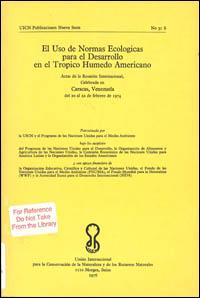
El uso de normas ecológicas para el desarrollo en el trópico húmedo americano : actas de la reunión internacional, celebrada en Caracas, Venezuela del 20 al 22 de febrero de 1974
Publication
1976
As the World Heritage Convention celebrates its 50th anniversary in 2022, over 1100 sites around the world are recognized as World Heritage – places that are so valuable to humanity that there conservation has been deemed our collective responsibility. Yet many of these exceptional places face increasing pressure from diverse types of development projects within and around the sites. Assessing the impacts of such projects is essential to both prevent damage to World Heritage and identify sustainable options. This Guidance and toolkit explains the process for achieving these goals. Offering practical tips and tools including checklists and a glossary, it provides a framework for conducting impact assessments for cultural and natural heritage sites.
Se espera que la presente Nota Informativa los oriente de manera sensible y respetuosa teniendo en cuento los muchos temas involucrados. Contiene hechos fundamentales acerca de las ICCA, sintetiza lecciones aprendidas, y ofrece recomendaciones para los gobiernos qui implementan el Programa de Trabajo sobre Áreas Protegidas del CDB (PoWPA). La Nota ofrece también consejos sintéticos sobre qué hacer y qué no hacer dirigidos a los gobiernos y la sociedad civil qui están comprometarget_idos en mantener los immensos beneficios de las ICCA en términos de conservación y sustento a los medios de vida.
Yaghnob National Nature Park was established in a remote mountainous region home to the Yaghnobi people, a community with ancestral ties to the area. The park creation shifted local land governance. Previously, pasture use was shaped by traditional ownership rights, long-term arrangements, and locally negotiated community practices.
Subsequently, park authorities control and allocate grazing areas through rentals, upending access for local, outside, and transiting herders. These changes fuel friction over access, trust, and decision-making. Community members are concerned grazing allocations lack environmental assessments or equitable access, while park staff must implement ambitious management plans in difficult terrain with limited experience.
In response, TNF supports a community-led advisory board. This voluntary, collaborative body connects locals, pastoralists, park staff, government authorities, and scientists to improve communication, strengthen coordination, resolve conflicts, and share conservation responsibilities.
The ISEA Scheme (Integrated System for Evaluation of Marine Protected Area Management Effectiveness) is a standardised framework developed to improve management effectiveness across Mediterranean Marine Protected Areas (MPAs). It responds to persistent challenges such as uneven management performance, limited technical capacity, fragmented governance arrangements, and the absence of a harmonised assessment system.
The scheme uses a structured set of indicators covering governance, planning, resource allocation, monitoring, enforcement, and stakeholder engagement. Through periodic self-assessment supported by external review, MPA managers identify strengths and weaknesses, define improvement priorities, and establish roadmaps for adaptive management.
By promoting comparability, accountability, and peer learning, the ISEA Scheme helps strengthen long-term MPA governance across the Mediterranean.
In the Kyrgyz Republic, pastures cover about 89% of agricultural land, and livestock production is a key sector and main source of income for rural communities. Over the past 20 years, livestock numbers have increased significantly, placing growing pressure on pasture ecosystems and leading to declining productivity. Climate change, including more frequent droughts and shifting precipitation patterns, further exacerbates these challenges. In response, a pasture management model was developed based on improved data collection and alignment of sustainable livestock use with biodiversity conservation. The model combines participatory data collection, pasture carrying capacity assessments, integration of ecological corridors into pasture planning, introduction of ecological thresholds, and regular monitoring with adaptive management. This integrated approach reduces pressure on pastures, enhances climate resilience, and balances livestock production with wildlife and ecosystem sustainability.
The Motagua River Basin Integrated Environmental Management Project aims to reduce land-based pollution and unintentional emissions of POPs that affect aquatic ecosystems—particularly marine and coastal ecosystems—through integrated watershed management and capacity building in Guatemala and Honduras. Within this framework, a pilot project was implemented to protect and restore water recharge areas in the Cerro San Gil Springs Protected Reserve, Puerto Barrios, Izabal, within the Las Escobas River basin, the municipality’s main water source. Through partnerships between public institutions, conservation organizations, and local communities, ecological restoration efforts, patrols, and conservation agreements were promoted. A total of 85 hectares were restored and 1,800 hectares were protected. The initiative benefited more than 32,000 residents and strengthened local governance for water and ecosystem conservation.
Guatemala is considered as one of the countries most vulnerable to climate change, facing threats to water and food security as well as livelihoods. Despite this, climate action has received insufficient consideration in the country’s development agenda and local planning.
To address these issues, the EbA-LAC program has collaborated with relevant institutional teams to establish a joint approach towards guiding municipalities in the incorporation of climate considerations into their planning and budgeting processes. Through advocacy actions, key actors have updated the public investment system to include adaptation products, providing a procedural framework for municipalities to access funding and include adaptation measures in municipal budgets. In addition, by improving inter-institutional coordination, facilitating joint municipal planning tools, as well as strengthening municipalitechnical capacities, EbA-LAC has succeeded in paving the way for municipalities to leverage synergies towards an increased resilience.
In Kyrgyzstan, livestock herding remains a cornerstone of rural livelihoods, yet inefficient resource use and unsustainable herd sizes are accelerating land degradation, increasing greenhouse gas emissions, and creating environmental and public health risks—all of which heighten the impacts of climate change. Ecotourism is often presented as a complementary livelihood option, but it also comes with its own set of challenges. These include ensuring that tours respect nature and do not harm protected areas, difficulties in connecting tour operators with new or remote destinations, limited local services and marketing capacity, and ensuring that tourism activities genuinely support conservation efforts.
Hubei Province, a key agricultural region in central China, boasts rich agrobiodiversity with over 6,200 crop varieties and 23 livestock species. However, policy focus on production intensification threatens traditional farming practices and the diversity of genetic resources for food and agriculture (GRFA). This Solution prioritizes in-situ agrobiodiversity conservation that reduces GRFA threats, exemplified by a project targeting three indigenous varieties—Yanzhi rice, Wudang tea, and black goat—and establishing demonstration sites in Xishui, Yunyang, and Danjiangkou to promote conservation approaches.
In Tanzania’s Rufiji Delta, mangroves cover over 53,000 hectares and sustain thousands of people with food, fuel, timber, and coastal protection. Yet, heavy dependence on these forests and weak enforcement of regulations have caused widespread degradation. To address this, communities in Nyamisati, Kiomboni, Mfisini, and Mchinga established the Salale Collaborative Mangrove Management Area under a Participatory Forest Management approach. This grassroots solution empowers local people to co-manage resources, strengthening governance, stewardship, and resilience. With support from partners such as USAID, UNEP, and the Nairobi Convention, communities have restored 10 hectares of mangroves and are actively involved in conservation planning. The initiative addresses habitat loss, livelihood insecurity, and climate threats by ensuring that local stakeholders are at the center of decision-making. The result is both ecological recovery and improved livelihoods, proving that community-led action can safeguard vital ecosystems.
Unite for Nature on the Path to 2045: A 20-Year Strategic Vision for the Union articulates IUCN’s commitment to “a just world that values and conserves nature” and establishes a clear direction for the next two decades. It guides collective efforts to safeguard biodiversity, inspire societal engagement, and drive transformative change toward a sustainable future.
Unite for Nature on the Path to 2045: A 20-Year Strategic Vision for the Union articulates IUCN’s commitment to “a just world that values and conserves nature” and establishes a clear direction for the next two decades. It guides collective efforts to safeguard biodiversity, inspire societal engagement, and drive transformative change toward a sustainable future.