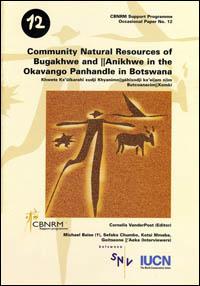
Community natural resources of Bugakhwe and ||Anichwe in the Okavango Panhandle in Botswana
Publication
2003
MyFarmTrees is a science-based digital platform incentivising farmer- and community-led restoration of degraded landscapes. Funded by the Global Environment Facility and executed by Alliance Bioversity-CIAT in partnership with IUCN, it combines mobile technology, blockchain and digital payments to trace every step from seed collection to tree growth. Seed collection, nursery work and tree establishment are tracked using geolocation, QR codes and photo evidence. Digital monitoring, reporting and verification (dMRV) is linked to payments for ecosystem services, rewarding species that support biodiversity, food systems and livelihoods. Farmers, communities, authorities and ministries co-govern restoration, receive mobile-money rewards for verified performance and access real-time data for reporting through frameworks such as the Restoration Barometer. Piloted in Kenya and Cameroon, MyFarmTrees has reached 6,000+ beneficiaries, planted 350,000 trees across 2,000+ ha and delivered over USD 500,000 in ecosystem-service payments.
As part of the Forests4Future project in Togo, which aims to rehabilitate degraded terrestrial ecosystems, an initiative was launched to raise awareness among schoolchildren about the importance of trees, environmental protection, and land restoration. Called “Environmental Education in Schools,” this initiative has led to the creation of nurseries managed by members of “Environmental Clubs.” The species planted are chosen based on each school’s environmental projects, such as green fences and arboretums. The pilot phase is taking place in 10 schools in Tchamba—5 elementary and 5 secondary schools—selected according to criteria established in consultation with all stakeholders. Each environmental club, composed of 20 students, maintains gender parity between boys and girls.
In Brûlé, a village in the Hauts de Saint-Denis region (Reunion Island), the project “Inspiring the Residents of Brûlé to Preserve Their Natural Heritage” addresses the significant pressure that invasive alien species (IAS) place on the village’s native and endemic habitats. Led by SREPEN — Réunion Nature Environnement — the project brings together families, schoolchildren, organizations, and volunteers around three initiatives: creating an arboretum of endemic and native species at Maison Roger, organizing work camps to combat IIS at Mamode Camp, and raising awareness among the public and in schools.
Co-funded by the European Union (BESTLIFE2030) and the City of Saint-Denis, with support from Réunion National Park, the ONF, and the Mascarin National Botanical Conservatory, the project mobilized more than 440 participants, planted more than 200 endemic and native seedlings, and removed approximately one metric ton of waste from pest control efforts, fostering a sustainable civic movement centered on the biodiversity of Le Brûlé.
Across 2036 km² of central Saudi Arabia, Nafud al-‘Urayq protects a distinctive cordon of dunes, rocky outcrops and ephemeral wetlands. The landscape formed part of Hima Ibil al-Sadaqah (traditional Protected Area), conserved for charity camels during the reign of Caliph Umar ibn al-Khattab (634–644 AD) while historical accounts also associate the wider al-Rabadhah hima with other early caliphs. National Center for Wildlife (NCW) has renewed this hima conservation tradition through ranger patrols, habitat protection, regulated camel transit, biodiversity monitoring and community engagement. These measures have supported habitat recovery, including dense, woodland-like stands of ‘ghada’ (Haloxylon persicum) with ‘arta’ (Calligonum comosum) trees, while safeguarding seasonal habitat for Asian Houbara Chlamydotis macqueenii and other migrants. Rehabilitation of habitats in collaboration with National Center for Vegetation Cover (NCVC) is continuing, and NCW is preparing a pilot releases of Arabian sand gazelle (Gazella marica).
Due to its small size, Seychelles has limited freshwater resources. It faces increasing pressures such as a growing population, agricultural pollution and climate change. Its government implemented “A Ridge to Reef Approach for the Integrated Management of Marine, Coastal and Terrestrial Ecosystem” (GEF-funded in partnership with UNDP). The approach is grounded in the understanding that activities on land directly impact the whole watershed.
A key project aim was to improve aquatic ecosystem management. To achieve this, project partners established a monitoring programme, creating Seychelles’ first water data baseline which provides a reference point to track future changes to support climate adaptation. The project also created technical capacity building opportunities and organized outreach activities to raise awareness of the importance of aquatic ecosystems. These activities help communities better prepare for climate-related challenges to freshwater security. Inter-sectoral coordination was at the heart of the project.
Aquaculture Trainings, like training in agriculture and many other areas, provide innovations, best practices, and lots of technical details. The audience usually has different levels of experience, including beinngers, advanced and professional learners. Designing and conducting a training that covers the needs of all without leaving anybody behind is key to success. The training content is highly relevant and at least as relevant is HOW the content is delivered. Well selected training methods and appropriate didactics keep the audience intersted and engaged for maximum learning success.
Wetlands in Sichuan Province face mounting pressures from infrastructure, tourism, invasive species, and reduced community engagement following resettlement. In response, the UNDP‑GEF Sichuan Wetland Conservation Project (2022–2027) developed an integrated model combining stronger policies, improved protected‑area management, community co‑management, sustainable livelihoods, and nature education. To date, the project has achieved notable ecological recovery: wetland conditions have improved, water quality has risen to cleaner levels, and declining species such as Ottelia acuminata, Eurasian otters, and Oriental storks have been recorded again. On the social side, participating households have seen a 10% income increase, with over 3,600 direct beneficiaries, more than half being women. The project has also cut carbon emissions by over 71,674 tCO₂e and engaged > 5.24 million people through World Wetlands Day outreach in 2025–2026. This framework now serves as a reference for wetland conservation across the Yangtze River Basen.
Saudi Arabia contains important cliff and mountain landscapes used by Barbary Falcons for breeding and foraging. The Hadad Program applies a structured, evidence-supported monitoring model centered on priority nesting sites. Instead of relying on difficult adult population counts, the solution uses these sites to track pair occupancy, incubation, chick development, fledging, and productivity. Field Rangers conduct repeated visits, document photographic evidence through standardized forms, and submit records for central Hadad data-quality review. The model addresses fragmented baseline information, sensitive nest locations, rugged field access, and inconsistent historical records. In 2025, Hadad recorded 77 active nesting sites across 5 regions and 129 fledglings. In 2026, coverage expanded to 8 regions and 106 active nesting sites to date. This reflects expanded monitoring and improved detection, not a direct population-growth estimate. The model strengthens conservation planning, performance review, and adaptive management
The project promoted restoration, prioritizing the following ecosystems: natural grasslands, native forests, wetlands, and coastal ecosystems.
The project achieved the following:
These experiences, framed within a national planning process, fuel inclusive debate and the creation of public policy on restoration, as well as contributing to the National Biodiversity Strategy. Among the overall environmental benefits the project aimed to generate, 11,164 ha of degraded land and ecosystems have been restored.
PROAMAZONÍA, an Ecuadorian initiative for 2017–2023, which reduced deforestation and CO2 emissions. It linked national efforts to reduce emissions, priority agendas, and productive policies within the REDD+ framework, as outlined in its REDD+ Action Plan “Forests for Good Living” (2016–2025). It succeeded in reducing emissions from deforestation by 7 million metric tons of CO2 equivalents, contributing to Ecuador’s NDC. Comprising projects funded by the GCF and GEF, it was implemented by MAATE, MAG, and UNDP.
It addressed four components: REDD+ policies and institutional framework, transition to sustainable production, sustainable forest management, conservation and restoration, and operational management of REDD+. It updated land-use planning instruments, facilitated the transition to sustainable production across 93,000 hectares, conserved and sustainably managed 790,000 hectares of forests, and restored 15,000 hectares of Amazonian forests, benefiting 83,000 people.
In Zambia’s Lower Kafue Sub-Catchment, rising water demand, climate change, and land degradation have reduced water availability and negatively impacted smallholder livelihoods. To address it, GIZ implemented the AWARE project, combining catchment restoration, climate-smart agriculture, and strengthening water governance.
Communities co-plan and implement low-cost Nature-based Solutions (NbS) – soil bunds, trenches, check dams – restoring degraded catchments and improve water availability. Downstream farmers apply climate-smart agricultural practices at demonstration sites. Gender-sensitive design ensures women lead and benefit equally. Community members are trained as local experts, sustaining results beyond the project cycle.
Water User Associations (WUAs) coordinate local action, while collaboration between line ministries and the Water Resources Management Authority (WARMA) aligns outcomes with national water governance. The approach informed Zambia’s national rainwater-harvesting strategy and is being scaled under AWARE 2
Marine protected area management in Alor depends on knowledge held by local communities, practitioners and managers who have learned through years of working with coastal and marine ecosystems. Much of this expertise has remained informal, locally held and insufficiently recognised. The Alor Marine Protected Area’s Center of Excellence (CoE), hosted by Universitas Tribuana Kalabahi, addresses this gap by making local and traditional scientific knowledge a foundation of its training model. Local practitioners serve as trainers and resource persons alongside academics and technical specialists. Learning combines 70% field practice with 30% theory across four laboratories: community, governance, biodiversity and corporation/private-sector practices. The model connects practical knowledge with research and competency-based learning, allowing experience generated in Alor to be documented, recognised and transferred to protected area managers, students and practitioners from other areas.