

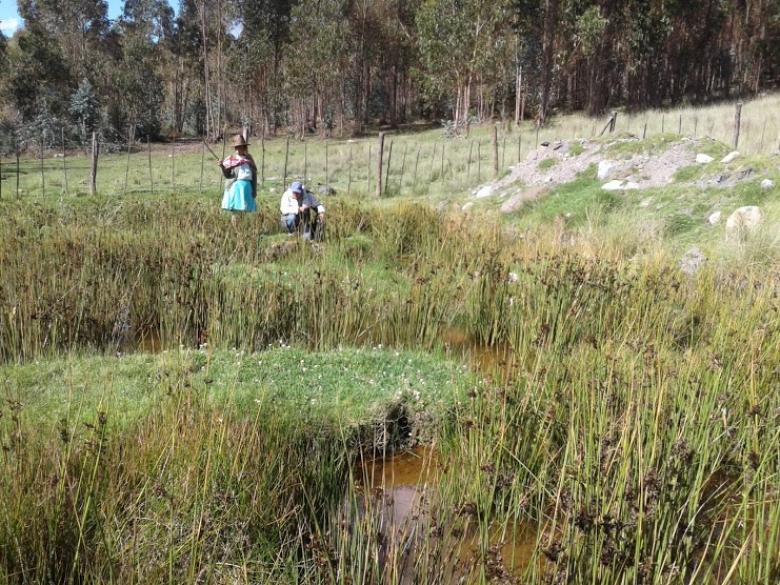
Biorremediación en la Comunidad Campesina Cordillera Blanca, Perú
The community, located in Huascarán National Park, is being affected by the natural contamination of the waters of the Negro River because glacial retreat has left rocks exposed in the mountains that generate acidification and dissolution of metals in the water due to rainfall runoff. This phenomenon is detrimental to the community members who are engaged in extensive cattle ranching on natural pastures. This initiative, implemented by the community and the Mountain Institute, involved participatory analysis and monitoring of water quality, training of local researchers, and a search for technological alternatives to solve the problem. Finally, bioremediation was chosen, whereby the water is purified by passing it through a series of rustic ponds in which sediments are decanted and then the capacity of native plants is used to absorb the contaminants. In this way, the quality of water for human and livestock consumption was improved.