

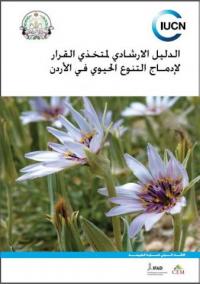
A toolkit for mainstreaming biodiversity in Jordan (Arabic version)
Publication
2015
Authors
El Shaer, Hany, Haddad, Fidaa F., Salem, Boshra
Un objetivo clave de esta guía es replantear la EIA para ayudar a apoyar la conservación de la biodiversidad y el logro de los objetivos globales relacionados (junto con los objetivos climáticos y otros objetivos de desarrollo social). Esta guía se centra en la biodiversidad y el desarrollo eólico y solar, y está dirigida principalmente a planificadores gubernamentales y promotores de proyectos. Sin embargo, dado que está diseñada para ayudar a abordar algunos de los desafíos existentes en la EIA, su aplicabilidad es potencialmente más amplia.
The guidelines call for and delineate standardised approaches, from collecting and storing samples to using and sharing data. Lastly, the guidelines illustrate which international and national regulations have to be considered. This document aims to be a resource that guides the reader through the fundamental decision processes for establishing, managing and implementing biobanks. Only through a harmonised and standardised approach within a global network will we be able to fully utilise the potential of biobanks across the world.
Un objectif clé de ce guide est de recadrer l’EIC pour aider à soutenir la conservation de la nature et la réalisation des objectifs mondiaux en matière de biodiversité (aux côtés des objectifs climatiques et autres objectifs de développement sociétaux). Ce guide est centré sur la biodiversité et le développement éolien et solaire, et s’adresse principalement aux planificateurs gouvernementaux et aux promoteurs de projets. Cependant, étant donné qu’il est conçu pour aider à relever certains des défis existants de l’EIC, sa portée est potentiellement plus vaste.
This document presents the findings of a comprehensive needs assessment conducted by the IUCN SSC CEC Behaviour Change Task Force. It is designed to provide a structured understanding of the challenges, opportunities, and actionable recommendations for integrating behavioural sciences into conservation strategies. The report aims to serve as both a diagnostic tool and a roadmap for advancing the application of behavioural sciences in conservation efforts.
As human-wildlife conflicts become more frequent, serious and widespread worldwide, they are notoriously challenging to resolve, and many efforts to address these conflicts struggle to make progress. These Guidelines provide an essential guide to understanding and resolving human-wildlife conflict. The Guidelines aim to provide foundations and principles for good practice, with clear, practical guidance on how best to tackle conflicts and enable coexistence with wildlife. They have been developed for use by conservation practitioners, community leaders, decision-makers, researchers, government officers and others. Focusing on approaches and tools for analysis and decision-making, they are not limited to any particular species or region of the world.
Tabe’a III addresses the status and trends in the implementation of the World Heritage Convention in the Arab region during the period from 2015 to 2019. This review was conducted in the context of emerging global trends and priorities associated with the World Heritage Convention, as well as other related global natural heritage platforms and programmes. Tabe’a III documents progress made in the conservation of natural and mixed World Heritage sites in the Arab region, as well as providing an update on the state of conservation of natural sites. Additionally, special themes address key priorities which have emerged from heritage protection, conservation challenges and opportunities arising in the region. Finally, there is a summary update on the Arab States’ lists of possible candidate sites, known as Tentative Lists, with notes on their development since the Tabe’a II report.
The key aim of this report is to outline how developers can start to act on supply chain biodiversity impacts by improving traceability and sourcing practices through. It is primarily aimed at developers of wind and solar projects and transmission infrastructure, who primarily source composite goods (e.g. wind turbines and solar panels).
The capacity of cities as landscapes to support biodiversity is accepted as one of the critical steps necessary to halt global biodiversity loss and also address the other two aspects of the triple planetary crisis, climate change and pollution. The intent of the report is to communicate opportunities for the integration of nature and biodiversity into the building scale, through the measures implemented within the individual building structure. The document provides context by reviewing global agreements and initiatives that support these themes, and discusses leading examples from global cities before providing a more in-depth review of the range of initiatives from eight European municipalities.
The need to transition to a lower carbon, naturesafe renewable energy-based economy is more urgent than ever. This report provides an overview of potential opportunities for biodiversity enhancement for wind and solar developments, bringing together information on good practice principles, case studies from industry practice, and a summary of existing approaches to biodiversity enhancement. It is intended as a compendium summary resource for developers, combining a variety of diffuse information from literature and community of practice.
In 2021, IUCN launched the IUCN Flagship Report Series, to help demonstrate the importance of conserving nature for human well-being and all life on Earth. This report, the second in the series, focuses on agriculture and nature. The interactions, synergies, and tradeoffs between the two sit at the heart of the 2030 Agenda for Sustainable Development, which calls for ending hunger and ensuring food security while also mandating the protection and restoration of nature. Whether the two can be achieved simultaneously, and if so how, are crucial questions for humanity and our planet. IUCN therefore explores the positive and negative relationships between agriculture and nature conservation and mobilises new modelling approaches to examine both imperatives within a range of realistic policies.
This website uses cookies so that we can provide you with the best user experience possible. Cookie information is stored in your browser and performs functions such as recognising you when you return to our website and helping our team to understand which sections of the website you find most interesting and useful.
Strictly Necessary Cookie should be enabled at all times so that we can save your preferences for cookie settings.
If you disable this cookie, we will not be able to save your preferences. This means that every time you visit this website you will need to enable or disable cookies again.
This website uses Google Analytics to collect anonymous information such as the number of visitors to the site, and the most popular pages.
Keeping this cookie enabled helps us to improve our website.
Please enable Strictly Necessary Cookies first so that we can save your preferences!
This website uses the following additional cookies:
(List the cookies that you are using on the website here.)
Please enable Strictly Necessary Cookies first so that we can save your preferences!
