

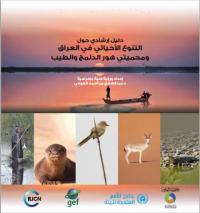
دليل إرشادي حول التنوع الأحيائي في العراق
Publication
2021
Authors
Al Oufi, Abdulhadi Ahmed
This document presents the findings of a comprehensive needs assessment conducted by the IUCN SSC CEC Behaviour Change Task Force. It is designed to provide a structured understanding of the challenges, opportunities, and actionable recommendations for integrating behavioural sciences into conservation strategies. The report aims to serve as both a diagnostic tool and a roadmap for advancing the application of behavioural sciences in conservation efforts.
Cette note d’information a pour objet d’aider les pays à reconnaître et à soutenir les territoires et les aires du patrimoine conservés par les peuples autochtones et les communautés locales (APAC), en restant sensibles et respectueux des nombreuses questions en cause. Elle contient des éléments de base sur les APAC ainsi qu’un condensé de leçons apprises, et des recommandations pour les gouvernements qui mettent en oeuvre le Programme de travail de la CDB sur les Aires protégées (PoWPA).
Se espera que la presente Nota Informativa los oriente de manera sensible y respetuosa teniendo en cuento los muchos temas involucrados. Contiene hechos fundamentales acerca de las ICCA, sintetiza lecciones aprendidas, y ofrece recomendaciones para los gobiernos qui implementan el Programa de Trabajo sobre Áreas Protegidas del CDB (PoWPA). La Nota ofrece también consejos sintéticos sobre qué hacer y qué no hacer dirigidos a los gobiernos y la sociedad civil qui están comprometarget_idos en mantener los immensos beneficios de las ICCA en términos de conservación y sustento a los medios de vida.
Un objetivo clave de esta guía es replantear la EIA para ayudar a apoyar la conservación de la biodiversidad y el logro de los objetivos globales relacionados (junto con los objetivos climáticos y otros objetivos de desarrollo social). Esta guía se centra en la biodiversidad y el desarrollo eólico y solar, y está dirigida principalmente a planificadores gubernamentales y promotores de proyectos. Sin embargo, dado que está diseñada para ayudar a abordar algunos de los desafíos existentes en la EIA, su aplicabilidad es potencialmente más amplia.
The guidelines call for and delineate standardised approaches, from collecting and storing samples to using and sharing data. Lastly, the guidelines illustrate which international and national regulations have to be considered. This document aims to be a resource that guides the reader through the fundamental decision processes for establishing, managing and implementing biobanks. Only through a harmonised and standardised approach within a global network will we be able to fully utilise the potential of biobanks across the world.
Les sociétés du monde entier exploitent les espèces sauvages, dans une mesure plus ou moins grande, pour l’alimentation, les matériaux de construction, les soins de santé, les médicaments, la lutte contre les parasites, l’ornementation, générer des revenus, les loisirs, ainsi qu’à des fins culturelles et spirituelles. Si cette utilisation des espèces sauvages contribue directement au bien-être de milliards de personnes dans le monde, la surexploitation des espèces sauvages est l’un des principaux facteurs de perte de biodiversité.
The Kunming-Montreal Global Biodiversity Framework, adopted in 2022, provides a framework for the effective implementation of the Convention on Biological Diversity (CBD) through four goals and 23 targets. Target 3 (known as the ‘30×30 target’) calls on Parties to conserve at least 30% of terrestrial, inland waters, and coastal and marine areas by 2030. These guidelines are designed to promote good practices relating to identifying, reporting, monitoring and strengthening OECMs. They are intended for use by a wide range of rightsholders and stakeholders to promote understanding of whether a site meets the CBD criteria for identifying an OECM, how to report OECM data at the national and global levels, and how to monitor and strengthen OECMs.
Un objectif clé de ce guide est de recadrer l’EIC pour aider à soutenir la conservation de la nature et la réalisation des objectifs mondiaux en matière de biodiversité (aux côtés des objectifs climatiques et autres objectifs de développement sociétaux). Ce guide est centré sur la biodiversité et le développement éolien et solaire, et s’adresse principalement aux planificateurs gouvernementaux et aux promoteurs de projets. Cependant, étant donné qu’il est conçu pour aider à relever certains des défis existants de l’EIC, sa portée est potentiellement plus vaste.
The Kunming-Montreal Global Biodiversity Framework, adopted in 2022, provides a framework for the effective implementation of the Convention on Biological Diversity (CBD) through four goals and 23 targets. Target 3 (known as the ‘30×30 target’) calls on Parties to conserve at least 30% of terrestrial, inland waters, and coastal and marine areas by 2030. These guidelines are designed to promote good practices relating to identifying, reporting, monitoring and strengthening OECMs. They are intended for use by a wide range of rightsholders and stakeholders to promote understanding of whether a site meets the CBD criteria for identifying an OECM, how to report OECM data at the national and global levels, and how to monitor and strengthen OECMs.
This document presents the findings of a comprehensive needs assessment conducted by the IUCN SSC CEC Behaviour Change Task Force. It is designed to provide a structured understanding of the challenges, opportunities, and actionable recommendations for integrating behavioural sciences into conservation strategies. The report aims to serve as both a diagnostic tool and a roadmap for advancing the application of behavioural sciences in conservation efforts.