

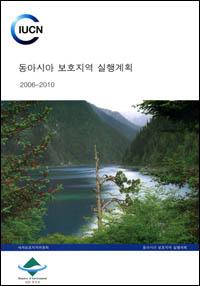
Regional action plan for the protected areas of East Asia 2006-2010 (Korean version)
Publication
2008
Authors
MacKinnon, John Ramsay, Xie Yan
In the context of accelerating global climate change, public awareness and participation in climate action across China remains limited. To address this, Friends of Nature launched the “Citizen Climate Action – Linglong Program” in 2021, with support from the Energy Foundation, the Beijing Xianfeng Changtian Foundation, and Partnerships for community Development. The program aims to identify and support individuals who already have a certain professional foundation but are at an early stage of engaging with climate issues. Through structured knowledge-building, mentorship, community support, and small grants, Linglong Program helps fellows design and implement citizen-led climate actions. By cultivating climate leaders and long-term change makers, the program establishes replicable and scalable models of climate action that inspire broader public engagement.
Hainan is a natural gene bank for tropical crop varieties which include many endemic crop varieties such as Shanlan rice, tropical native melons, beans, solanaceous vegetables as well as 15 local breeds of livestock. However, intensive agriculture development, environmental pollution, invasive alien species, urbanization, attrition of traditional production systems, fragmentation, degradation of habitats and climate change put increasing pressure on agrobiodiversity conservation and sustainable use. This Solution presents how conservation and sustainable use of local agricultural genetic diversity in Hainan Province were promoted through the development of incentive mechanisms for farmers to sustain populations of endemic crops and livestock, the establishment of a supportive enabling environment and strengthened institutional capacity.
“Cycad Yam” derives its name from the villagers living around the Sichuan Panzhihua Cycad National Nature Reserve, who collected high-quality yam seeds growing in the reserve as germplasm resources for artificial propagation under the guidance of staff from the Protection Center. Traditional digging activities by villagers around the reserve are restricted by the reserve’s relevant laws and regulations, leading to conflicts between ecological conservation efforts and villagers’ livelihoods. Through introduction and cultivation, technical support, and industrial upgrading, a “reserve + community” joint construction model has been established. This initiative provides both ecological and economic benefits, achieving a win-win outcome for ecological conservation and rural revitalization, boosting income for approximately 300 households, and establishing Cycad Yam as a characteristic industry promoting common prosperity in the local area.
The Indigenous Paiwan Kuskus Tribe, located in Mudan Township, Pingtung County, Taiwan, has an estimated 600-year history based on archaeological evidence. The Pingtung Branch of the Forestry and Nature Conservation Agency has long supported the tribe through forest and resource surveys, tribal mapping, and documentation of traditional practices in farming, fishing, hunting, and settlement. In 2021, the Branch co-organized Resilience Assessment Workshops (RAWs) with the Kuskus community, engaging elders, the village head, the community development association, and the youth association. The workshops identified key challenges—such as the need to strengthen ecological stewardship by weaving Indigenous knowledge with modern technologies, water scarcity, illegal logging and poaching, and natural disasters affecting farming and livestock—and helped shape solutions focused on conserving and using local resources, promoting traditional knowledge, improving governance, and enhancing family livelihoods and welfare.
The role of national parks as spaces for responding to the climate crisis is becoming important. Ecotourism programs within these parks are being reimagined as tools for sustainable use management, supporting both park conservation and local sustainability. These initiatives present a hopeful vision for the future of parks and their surrounding regions through collaborative local engagement.
The Hakbong-ri pottery kiln site in Gyeryongsan is a culturally significant heritage location, showcasing Korea’s ceramic tradition from the 14th to 16th centuries. As a large-scale excavation site of Buncheong ware with iron-brown underglaze, it reflects a remarkable revival of the style during its mid-16th century decline.
This program was designed to foster responsible stewardship of national parks and local heritage sites. It encourages citizens—including local residents—to recognize the site’s value through systems thinking that connects individuals, the park, and the broader community, while fostering active regional partnerships.
Nestled in Heilongjiang Province, Wudalianchi Geological Park is a UNESCO Biosphere Reserve famed for its 14 volcanoes, expansive lava fields, five interconnected lakes, and numerous mineral springs. This “natural volcano museum” showcases world-class volcanic geo-heritage, premium therapeutic mineral water, and a unique health rehabilitation ecosystem. To address challenges like high population density and local dependence on natural resources, the park adopted a people-centered approach. It promotes sustainable development by creating specialty industries and engaging communities in conservation. This strategy has raised local incomes, turning residents into active conservation partners, and successfully balancing ecological protection with economic growth, proving that “green mountains are gold mountains.”
In Mongolia, 77% of the soil is degraded due to activities such as agricultural expansion and mining, while poaching has threatened the snow leopard and other native animals. Insufficient spending on biodiversity largely contributed to this. Although the 2012 Natural Resource Use Fees Law (NRUF) states that a minimum share of the revenues from fees for using natural resources must be spent on conservation and restoration, the law was not effectively implemented by local governments. In 2021, Mongolia only spent 0.2% of its gross domestic product (GDP) on biodiversity.
Amid this scenario, BIOFIN supported Mongolia in strengthening the implementation of the NRUF. This process included 1) analyzing existing regulations and drafting new ones; 2) creating a public database to track environmental expenditures; and 3) building capacity and raising awareness.
As a result, Mongolia spent USD 13.98 million on biodiversity in 2024, an increase of 225% compared to 2021, and more than doubling the projected USD 5-6 million per year.
Unite for Nature on the Path to 2045: A 20-Year Strategic Vision for the Union articulates IUCN’s commitment to “a just world that values and conserves nature” and establishes a clear direction for the next two decades. It guides collective efforts to safeguard biodiversity, inspire societal engagement, and drive transformative change toward a sustainable future.
Unite for Nature on the Path to 2045: A 20-Year Strategic Vision for the Union articulates IUCN’s commitment to “a just world that values and conserves nature” and establishes a clear direction for the next two decades. It guides collective efforts to safeguard biodiversity, inspire societal engagement, and drive transformative change toward a sustainable future.
Unite for Nature on the Path to 2045: A 20-Year Strategic Vision for the Union articulates IUCN’s commitment to “a just world that values and conserves nature” and establishes a clear direction for the next two decades. It guides collective efforts to safeguard biodiversity, inspire societal engagement, and drive transformative change toward a sustainable future.
«Unidos por la naturaleza en el camino hacia 2045: una visión estratégica de 20 años para la Unión» articula el compromiso de la UICN con «un mundo justo que valora y conserva la naturaleza» y establece una dirección clara para las próximas dos décadas. Orienta los esfuerzos colectivos para salvaguardar la biodiversidad, inspirar el compromiso social e impulsar un cambio transformador hacia un futuro sostenible.
«Unidos por la naturaleza en el camino hacia 2045: una visión estratégica de 20 años para la Unión» articula el compromiso de la UICN con «un mundo justo que valora y conserva la naturaleza» y establece una dirección clara para las próximas dos décadas. Orienta los esfuerzos colectivos para salvaguardar la biodiversidad, inspirar el compromiso social e impulsar un cambio transformador hacia un futuro sostenible.
This website uses cookies so that we can provide you with the best user experience possible. Cookie information is stored in your browser and performs functions such as recognising you when you return to our website and helping our team to understand which sections of the website you find most interesting and useful.
Strictly Necessary Cookie should be enabled at all times so that we can save your preferences for cookie settings.
If you disable this cookie, we will not be able to save your preferences. This means that every time you visit this website you will need to enable or disable cookies again.
This website uses Google Analytics to collect anonymous information such as the number of visitors to the site, and the most popular pages.
Keeping this cookie enabled helps us to improve our website.
Please enable Strictly Necessary Cookies first so that we can save your preferences!
This website uses the following additional cookies:
(List the cookies that you are using on the website here.)
Please enable Strictly Necessary Cookies first so that we can save your preferences!
