
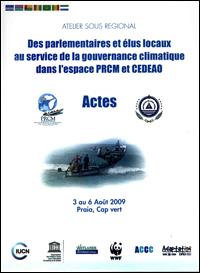
Atelier sous régional des parlementaires et élus locaux au service de la gouvernance climatique dans l'espace PRCM et CEDEAO : actes
Publication
2009
Guatemala is considered as one of the countries most vulnerable to climate change, facing threats to water and food security as well as livelihoods. Despite this, climate action has received insufficient consideration in the country’s development agenda and local planning.
To address these issues, the EbA-LAC program has collaborated with relevant institutional teams to establish a joint approach towards guiding municipalities in the incorporation of climate considerations into their planning and budgeting processes. Through advocacy actions, key actors have updated the public investment system to include adaptation products, providing a procedural framework for municipalities to access funding and include adaptation measures in municipal budgets. In addition, by improving inter-institutional coordination, facilitating joint municipal planning tools, as well as strengthening municipalitechnical capacities, EbA-LAC has succeeded in paving the way for municipalities to leverage synergies towards an increased resilience.
Ce rapport apporte une contribution importante à la compréhension du sens et des implications d’une nutrition durable, un concept puissant au cœur de la mission de notre conseil scientifique. En rassemblant des informations pertinentes sous des angles socioéconomique, environnemental, nutritionnel et de perception sociale, le présent rapport identifie les principales inconnues susceptibles de devenir des aspects importants dans nos études sur l’intelligence artificielle et les mégadonnées.
Formal registration as an NGO granted Western Indian Ocean Mangrove Network (WIOMN) essential funding access, legal identity, legitimacy, and governance needed to fulfill its mission. Although founded in 2011 with members across 10 countries, WIOMN lacked formal NGO status, limiting its potential and stakeholder recognition. To address this, WWF, IUCN, and Wetlands International formed a consortium providing technical and financial support, enabling WIOMN’s successful registration in 2021. Since then, the network secured international project funding and was appointed by the Nairobi Convention to lead the Regional Mangrove Action Plan (RMAP) development.
In Tanzania’s Rufiji Delta, mangroves cover over 53,000 hectares and sustain thousands of people with food, fuel, timber, and coastal protection. Yet, heavy dependence on these forests and weak enforcement of regulations have caused widespread degradation. To address this, communities in Nyamisati, Kiomboni, Mfisini, and Mchinga established the Salale Collaborative Mangrove Management Area under a Participatory Forest Management approach. This grassroots solution empowers local people to co-manage resources, strengthening governance, stewardship, and resilience. With support from partners such as USAID, UNEP, and the Nairobi Convention, communities have restored 10 hectares of mangroves and are actively involved in conservation planning. The initiative addresses habitat loss, livelihood insecurity, and climate threats by ensuring that local stakeholders are at the center of decision-making. The result is both ecological recovery and improved livelihoods, proving that community-led action can safeguard vital ecosystems.
Unite for Nature on the Path to 2045: A 20-Year Strategic Vision for the Union articulates IUCN’s commitment to “a just world that values and conserves nature” and establishes a clear direction for the next two decades. It guides collective efforts to safeguard biodiversity, inspire societal engagement, and drive transformative change toward a sustainable future.
Unite for Nature on the Path to 2045: A 20-Year Strategic Vision for the Union articulates IUCN’s commitment to “a just world that values and conserves nature” and establishes a clear direction for the next two decades. It guides collective efforts to safeguard biodiversity, inspire societal engagement, and drive transformative change toward a sustainable future.
Unite for Nature on the Path to 2045: A 20-Year Strategic Vision for the Union articulates IUCN’s commitment to “a just world that values and conserves nature” and establishes a clear direction for the next two decades. It guides collective efforts to safeguard biodiversity, inspire societal engagement, and drive transformative change toward a sustainable future.
«Unidos por la naturaleza en el camino hacia 2045: una visión estratégica de 20 años para la Unión» articula el compromiso de la UICN con «un mundo justo que valora y conserva la naturaleza» y establece una dirección clara para las próximas dos décadas. Orienta los esfuerzos colectivos para salvaguardar la biodiversidad, inspirar el compromiso social e impulsar un cambio transformador hacia un futuro sostenible.
«Unidos por la naturaleza en el camino hacia 2045: una visión estratégica de 20 años para la Unión» articula el compromiso de la UICN con «un mundo justo que valora y conserva la naturaleza» y establece una dirección clara para las próximas dos décadas. Orienta los esfuerzos colectivos para salvaguardar la biodiversidad, inspirar el compromiso social e impulsar un cambio transformador hacia un futuro sostenible.
«Unidos por la naturaleza en el camino hacia 2045: una visión estratégica de 20 años para la Unión» articula el compromiso de la UICN con «un mundo justo que valora y conserva la naturaleza» y establece una dirección clara para las próximas dos décadas. Orienta los esfuerzos colectivos para salvaguardar la biodiversidad, inspirar el compromiso social e impulsar un cambio transformador hacia un futuro sostenible.
This website uses cookies so that we can provide you with the best user experience possible. Cookie information is stored in your browser and performs functions such as recognising you when you return to our website and helping our team to understand which sections of the website you find most interesting and useful.
Strictly Necessary Cookie should be enabled at all times so that we can save your preferences for cookie settings.
If you disable this cookie, we will not be able to save your preferences. This means that every time you visit this website you will need to enable or disable cookies again.
This website uses Google Analytics to collect anonymous information such as the number of visitors to the site, and the most popular pages.
Keeping this cookie enabled helps us to improve our website.
Please enable Strictly Necessary Cookies first so that we can save your preferences!
This website uses the following additional cookies:
(List the cookies that you are using on the website here.)
Please enable Strictly Necessary Cookies first so that we can save your preferences!
